Set up timezones
Model your warehouse data and configure your project so timezones behave predictably
tl;dr: store timestamps as timezone-aware types, use DATE for calendar values, and set your project timezone to the zone you report in.
Timezone conversion
Qyra converts the timezones of your data from their source timezone to a report timezone:
- Source timezone is the timezone of the raw data. It is defined in your warehouse, data types, modelling, and connection settings.
- Report timezone is the timezone you want to see in your results. It is defined by the project/user preferences, and specific chart/dashboard configuration.
Pick the right column types in your warehouse
Store your event timestamps as timezone-aware types. They unambiguously identify a moment in time and require no extra configuration. If you choose a naive timestamp it's timezone will be assumed to be in UTC unless you have configured the default data timezone.
| ✅ Use this (timezone-aware) | ❌ Avoid this (timezone naive) | |
|---|---|---|
| Warehouse type | TIMESTAMPTZ, TIMESTAMP WITH TIME ZONE, TIMESTAMP_LTZ, TIMESTAMP_TZ | TIMESTAMP_NTZ, TIMESTAMP WITHOUT TIME ZONE,DATETIME |
| Timezone | Timezone baked into each timestamp | Timezone assumed from default data timezone (default UTC) |
Use DATE only for calendar values
If a column represents a calendar date rather than a moment in time, store it as DATE. Qyra treats DATE columns as fixed calendar dates and never shifts them: 2024-03-15 stays 2024-03-15 regardless of the project timezone.
Use DATE for values like:
- A user's date of birth
- A subscription start date
- An anniversary
- A fiscal-period boundary
DATE is not what you want for event timestamps.
Don't store dates as strings. A value like '2024-03-15' in a VARCHAR column is opaque to both the warehouse and Qyra: sorting and range filters break, and every operation needs a cast. Convert string dates to a proper DATE or TIMESTAMP type in your dbt model.
Configure your connection
For timestamps without timezones (naive timestamps), we assume they follow the default data timezone. You can configure this in your warehouse connection settings:
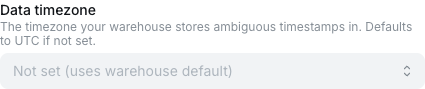
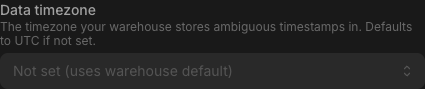
- If all your naive timestamps are in UTC (very common, since most ELT pipelines normalize to UTC): leave it as UTC.
- If your naive timestamps are in a single non-UTC zone (e.g. an on-prem system that logs in local time): set the data timezone to that zone. Qyra will interpret naive values as being in that zone.
- If your naive timestamps have a mix of timezones - we currently don't support overriding the timezone on a per-column level. Reach out to the team if you have a use case. If it's an option, consider re-modelling your data in a timezone-aware type.
Configure your project timezone
In Project settings → Timezone, pick the zone you want reports to use. Qyra will convert all reports from the raw data timezone into the project timezone. This is the zone in which:
- Timestamps are displayed in tables, on chart axes, and in exports.
- "Today" and "yesterday" are computed in relative date filters.
- Data is bucketed in a per-day grouped bar chart.
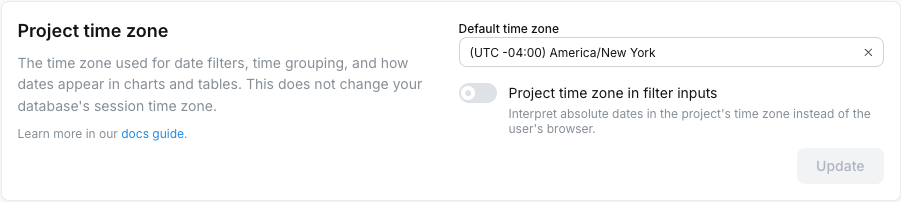
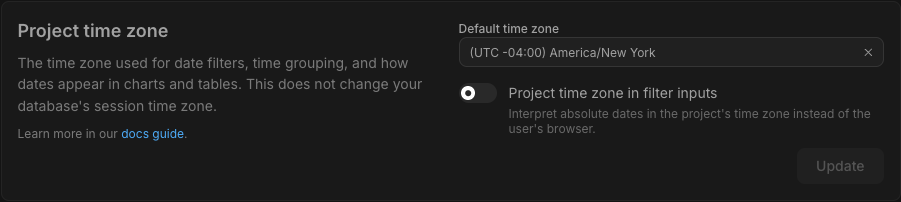
By default the project timezone is UTC, which means all reports in Qyra default to showing results in UTC. The project timezone can be customised per chart or user.
Opt a column out of timezone conversion
Most columns don't need annotations. The main exception is system or audit columns where you want the raw stored value displayed, with no shift to the project timezone:
columns:
  - name: created_at_utc
    config:
      meta:
        dimension:
          type: timestamp
convert_timezone: falsecolumns:
- name: created_at_utc
meta:
dimension:
type: timestamp
convert_timezone: falsedimensions:
- name: created_at_utc
type: timestamp
convert_timezone: falseUse cases: audit logs, system timestamps, pre-converted values. The column renders exactly what the warehouse stores.
DATE columns need no annotation. If you declare a column as type: date, Qyra treats it as a calendar value with no timezone applied, and renders it as-is.
Override a column timestamp domain
Qyra reads whether a timestamp column is timezone-aware or naive from your warehouse catalog, so you don't usually need to set this. Override it when the warehouse type doesn't match how the data is stored, for example a TIMESTAMP_NTZ column that already holds UTC instants.
Set timestamp_domain to aware or naive:
columns:
  - name: created_at
    config:
      meta:
        dimension:
          type: timestamp
timestamp_domain: awarecolumns:
- name: created_at
meta:
dimension:
type: timestamp
timestamp_domain: awaredimensions:
- name: created_at
type: timestamp
timestamp_domain: awareThe YAML value wins over the catalog. It's ignored on dimensions with custom sql and on additional dimensions, since the expression may change the domain. Interval children (_day, _month, ...) inherit from their base.
Naming conventions
Qyra doesn't enforce naming, but consistent suffixes make a model easier to read:
..._atfor timezone-aware timestamps (e.g.,created_at,purchased_at)...._datefor calendarDATEcolumns (e.g.,signup_date,effective_date)...._at_utcfor columns you've explicitly markedconvert_timezone: false.
Calendar dates vs timestamps: what shifts
Whether a column moves with the chart's timezone depends on its type, not its name:
TIMESTAMPcolumns identify a moment in time, so they shift into the resolved timezone.DATEcolumns are calendar values with no clock, so they never shift.2024-03-15stays2024-03-15for every viewer.
The same rule applies to a time interval built from a column. A day, week, or month grouping of a timestamp produces a calendar value, so its buckets move with the timezone. An hour-or-finer grouping stays a timestamp.
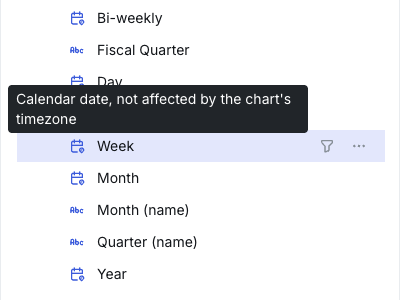
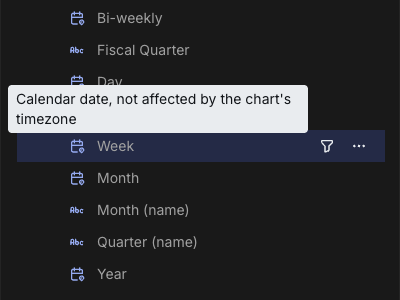
You can see which is which before you build. The dimension list shows an indicator next to each date and time dimension. Hover it for the detail:
| Dimension | Indicator | What it means |
|---|---|---|
| Timestamp | Default icon, "Timestamp, shifts with the chart's timezone" | Renders in the resolved timezone. |
| Day-or-coarser interval of a timestamp | Default icon, "Calendar date, shifts with the chart's timezone" | Bucket boundaries move with the timezone. |
DATE column | Calendar pin, "Calendar date, not affected by the chart's timezone" | Never shifts. |
Timestamp with convert_timezone: false | Clock pin, "Timestamp shown as stored, not affected by the chart's timezone" | Shown exactly as stored. |
Verify your setup
Before building dashboards, run a quick smoke test:
- Open Explore on a model with a known timestamp column.
- Group by that dimension at Day granularity.
- Compare a few rows against the raw warehouse data.
If the dates match what you'd expect for your project timezone, you're set. If they're off by a fixed amount, the connection's data timezone is the first thing to check.
Once your data and project are configured, Timezones in daily use covers how each chart resolves its timezone and how filters, dashboards, and scheduled deliveries behave.