Qyra MCP server
Connect Claude, ChatGPT, and Codex to your Qyra data over the Model Context Protocol
Available to all Qyra Cloud users.
The Model Context Protocol (MCP) lets external AI assistants — Claude, ChatGPT, OpenAI Codex, and custom agents — connect to Qyra and query your data directly. Qyra runs the MCP server and your assistant is the client, so it can explore your data models, search for metrics and dimensions, run queries, and surface data-driven insights through natural conversation. MCP uses secure OAuth authentication and respects all your existing access controls, so data stays protected.
This is for pointing an outside assistant into Qyra. To give your Qyra agents tools from outside services like Notion, Linear, or Confluence, that's the reverse direction — see Connect external MCP servers.
With MCP, your AI assistant becomes a data analyst that can:
- Browse and understand your data models
- Find relevant metrics and dimensions
- Run queries and generate visualizations
- Discover existing charts and dashboards, including verified content
- Create and edit charts and dashboards using content-as-code
- Leverage your AI agents' domain expertise and verified answers
- Switch between different projects seamlessly
- Respect your data governance and access controls
MCP respects all your existing Qyra permissions and user attributes. MCP clients can only access the data that your user account has permission to view.
Get started
Setting up MCP is quick and straightforward. You can connect your AI assistant to your Qyra instance in just a few minutes.
Prerequisites
- A Qyra Cloud account or Enterprise account with MCP enabled
- An MCP-compatible AI assistant (e.g., Claude.ai, Claude Desktop, ChatGPT, OpenAI Codex)
Find your instance name
Your instance name is the subdomain of the URL you use to open Qyra in your browser. Open Qyra, look at the address bar, and take the part before .qyraflow.com:
| Your Qyra URL | Instance name | MCP URL |
|---|---|---|
https://app.qyraflow.com/... | app | https://app.qyraflow.com/api/v1/mcp |
https://eu1.qyraflow.com/... | eu1 | https://eu1.qyraflow.com/api/v1/mcp |
https://acme.qyraflow.com/... | acme | https://acme.qyraflow.com/api/v1/mcp |
For most Qyra Cloud users the instance name is app or eu1. That's expected, not a placeholder you need to change. Only dedicated instances have a company-specific name like acme.
If you self-host Qyra on your own domain, the MCP endpoint lives at https://<your-qyra-host>/api/v1/mcp instead. See MCP for self-hosted instances.
Network requirements
If your organization uses a corporate firewall, VPN, or internet security tool, the following domains must be allowlisted for MCP to work correctly:
| Domain | Purpose |
|---|---|
<your_instance_name>.qyraflow.com | Qyra API and OAuth authentication |
claudemcpcontent.com | Used by Claude to render visual content (charts, tables) from MCP connectors |
If claudemcpcontent.com is blocked, Claude will still return query results as text but will not be able to display Qyra visual charts. You may see the error: "Failed to set up MCP app. Check that claudemcpcontent.com is not blocked by your network or browser."
If you're having trouble, try opening Claude in an incognito or private browser window to rule out browser extensions such as ad blockers that may be blocking these domains.
Installation
Claude.ai (Web & Desktop Apps)
Set up MCP in the Claude.ai web app, and it will automatically sync to your Claude Desktop app after restart.
ChatGPT (Web App)
ChatGPT support for MCP is coming soon! Stay tuned for updates.
OpenAI Codex
Claude Code CLI
For developers using Claude Code CLI:
claude mcp add qyra https://<your_instance_name>.qyraflow.com/api/v1/mcp -t httpReplace <your_instance_name> with your actual Qyra instance name (commonly app or eu1, see Find your instance name).
Cursor Editor
Navigate to Cursor Settings > MCP & Integrations
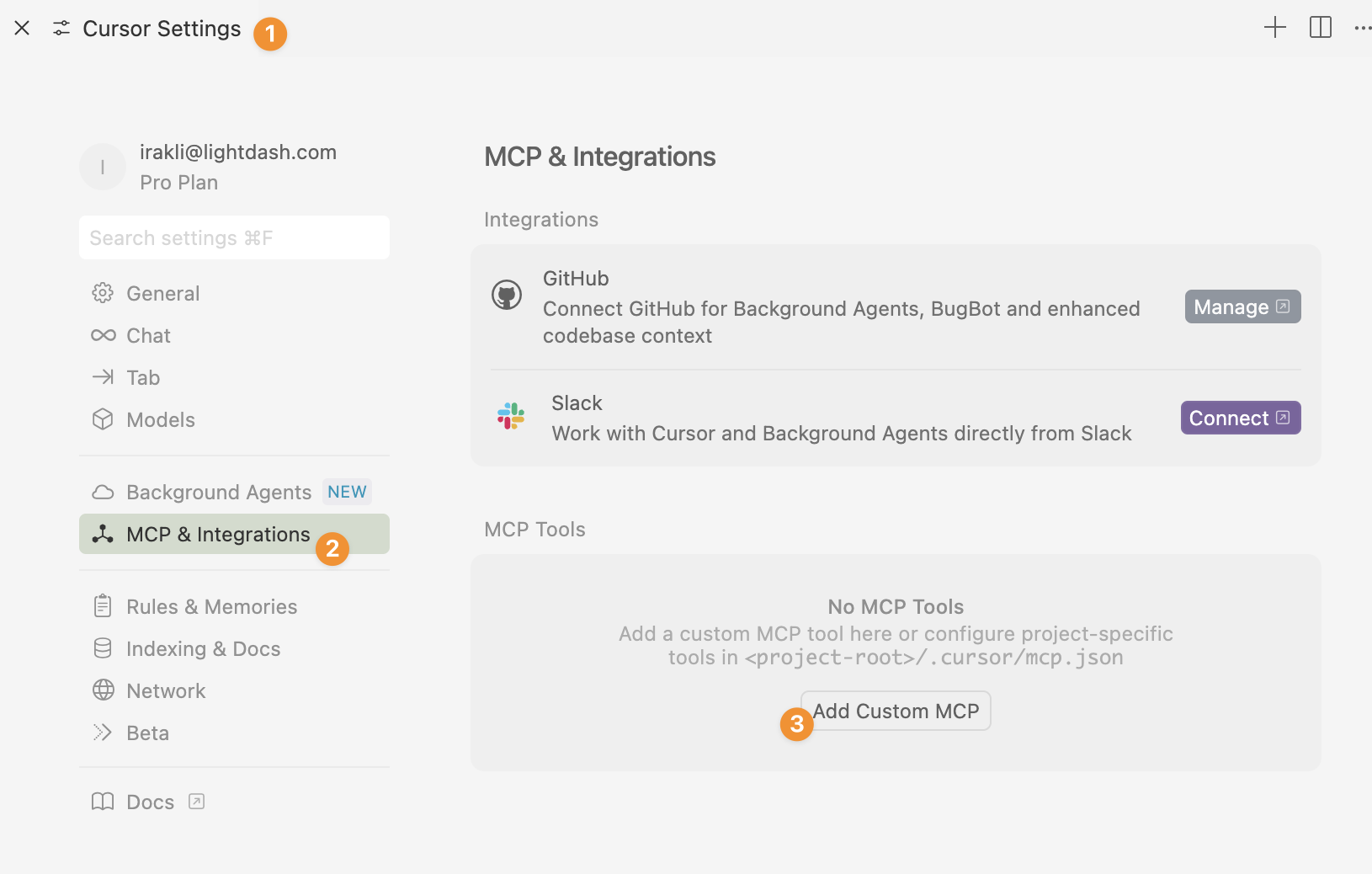
Custom Integration (For Developers)
If you're building your own agents or automated workflows, you can integrate directly with Qyra MCP:
- Transport: Qyra MCP exposes a StreamableHTTP transport endpoint at
https://<your_instance_name>.qyraflow.com/api/v1/mcp - Debugging: Use
@modelcontextprotocol/inspectorto inspect and debug the MCP connection - Authentication: For interactive setups use OAuth 2.0. For headless agents and automated workflows, you can authenticate with a Personal Access Token by passing it in the
Authorizationheader — bothAuthorization: ApiKey ldpat_<redacted>andAuthorization: Bearer ldpat_<redacted>are accepted on the MCP endpoint and resolve to the same PAT authentication path. TheBeareralias is accepted only on the MCP endpoint. UseBearerwhen your MCP host only supports staticBearertokens (for example, Claude managed agents and other third-party MCP hosts that don't let you choose a custom auth scheme); useApiKeyfor direct HTTP clients where you can set the scheme yourself, since it makes it explicit that the token is a Qyra PAT. Create the token under Settings → Personal access tokens for the user whose permissions and attributes you want the integration to use. Service account tokens are also supported on plans that include them. - Documentation: See the MCP specification for implementation details
- Pin a project (optional): pass
X-Qyra-Project: <project-uuid>to scope the MCP session to a specific project, skipping theset_projectstep. See details below. - Override user attributes per request (optional): pass
X-Qyra-User-Attributes: <json>to override the authenticated user's attributes for that request (useful for row-level security when an agent acts on behalf of different end-users). See details below.
Pin a project with the X-Qyra-Project header
By default, MCP clients use set_project to choose an active project, and the selection is stored as a per-user context. If you're building an integration that should always operate against a single project, you can pre-select the project by sending the X-Qyra-Project header on every request to /api/v1/mcp.
When the header is set:
- The project UUID in the header is used as the active project for that request, overriding any project previously set with
set_project. - The
list_projectsandset_projecttools are hidden fromtools/list, so the AI assistant can't change the project for the request. - Access to the project is still enforced by your user, API key, or service account's permissions — the header can't be used to access projects the caller can't already see.
This is useful when you want each integration, workspace, or environment to be locked to one project (for example, a separate connector per project) without relying on the AI assistant to call set_project first.
The header value must be a valid project UUID. You can find the project UUID in the Qyra URL when viewing a project (/projects/<projectUuid>/...).
{
  "mcpServers": {
    "qyra-sales": {
      "url": "https://<your_instance_name>.qyraflow.com/api/v1/mcp",
      "headers": {
        "X-Qyra-Project": "00000000-0000-0000-0000-000000000000"
      }
    }
  }
}curl https://<your_instance_name>.qyraflow.com/api/v1/mcp \
-H "Authorization: Bearer <your_token>" \
-H "X-Qyra-Project: 00000000-0000-0000-0000-000000000000" \
-H "Content-Type: application/json" \
-d '{"jsonrpc":"2.0","id":1,"method":"tools/list"}'If the header value isn't a valid UUID, it's ignored and the request falls back to the user's stored project context. Permissions are always checked against the resolved project, so a header for a project the caller can't view will return a "no access" error.
Override user attributes with the X-Qyra-User-Attributes header
The X-Qyra-User-Attributes header overrides the authenticated user's Qyra user attributes for that specific MCP request. This is designed for agents that act on behalf of multiple end-users with row-level security: one PAT (or service account) user handles all requests, and per-request RLS scoping is applied via the header.
The PAT or service account user must have the org admin role to use this header. Non-admins will receive a ForbiddenError.
The header value must be a JSON object where each value is either a string or an array of strings. For example:
{"user_id": "abc123"}{"user_id": ["abc123", "def456"]}
If the agent user already has a value set for an attribute, the header can only narrow that value (set a subset of the pre-configured values), not expand access. If no value is pre-configured for the attribute on the agent user, any value can be set via the header.
curl https://<your_instance_name>.qyraflow.com/api/v1/mcp \
  -H 'Authorization: ApiKey <your_token>' \
  -H 'X-Qyra-User-Attributes: {"user_id": "abc123"}' \
  -H 'Content-Type: application/json' \
  -d '{"jsonrpc":"2.0","id":1,"method":"tools/list"}'
{
"mcpServers": {
"qyra-agent": {
"url": "https://<your_instance_name>.qyraflow.com/api/v1/mcp",
"headers": {
"X-Qyra-User-Attributes": "{"user_id": "abc123"}"
}
}
}
}Setting the header statically in an MCP client config is suitable for development and testing. For production, where the attribute needs to change per end-user, the calling application must set the X-Qyra-User-Attributes header programmatically on each request.
What it can do
Core capabilities
MCP provides AI assistants with powerful tools to interact with your Qyra data:
Project management
- List projects - View all accessible projects in your organization
- Set active project - Switch context between different projects (required before accessing any data). Accepts an optional
tagsarray to filter the explores and fields visible in the session to those matching the given tags — the same tag-based filtering used by AI agents, but available directly in an MCP session without needing an agent. Useful when tags work in the Qyra UI but you also want to scope an MCP session to a specific domain (e.g.,["sales"]). - Get current project - Check which project is currently active
An active project must be set before MCP can retrieve any data. Your AI assistant will typically handle this automatically by listing available projects and asking you to select one.
Data exploration
- List explores - See all available data models in the current project at a glance
- Find explores - Search for relevant data models using natural language (e.g., "customer orders")
- Find fields - Search for specific metrics and dimensions by business terms (e.g., "total revenue", "order date")
- Search field values - Look up valid values for a field, useful for building filters
- Find content - Search for existing spaces, charts, and dashboards by name or description. Results include space breadcrumbs and direct links. Optionally scope the search to a single space (and its descendants) by passing a space slug.
- List content - Browse accessible content as a hierarchy. By default it returns root-level spaces; pass a space slug to list the charts, dashboards, and nested spaces directly inside that space. Use this when you want the agent to walk space → content rather than search by keyword.
- List verified content - Discover charts and dashboards that admins have marked as verified, so agents can reference trusted, canonical patterns when building new content. If you want your agent to prefer verified patterns, ask it to in your prompt (e.g. "Use verified charts as the reference for any new chart you build.").
Query execution
- Run metric query - Execute queries using your semantic layer's metrics and dimensions. Completed results include a best-effort
exploreUrlso you can open the query in Qyra to keep exploring. - Render chart - Render a visualization (tables, bar charts, line charts, pie charts, and more) for a completed metric query result in MCP App-capable clients (e.g., Claude). Call this after a metric query finishes when you want a visual chart; the query is not re-executed. SQL Runner results are not supported by
render_chart. - Run SQL - Execute arbitrary SQL queries directly against the project's data warehouse. Useful for ad-hoc analysis or queries that don't fit the explore-based model. Returns up to 500 rows by default (configurable up to 5,000). Completed results include a best-effort
sqlRunnerUrlso you can open the compiled SQL in SQL Runner. - Get query result - Poll for the result of a long-running query. If
run_metric_queryorrun_sqldoesn't finish within its wait window, the tool returns aqueryUuidand the assistant pollsget_query_resultuntil the warehouse completes the query — so long queries don't time out the session.
Run SQL requires the manage SqlRunner permission. The SQL is executed directly against your warehouse, so use the appropriate SQL dialect for your connection (e.g., PostgreSQL, BigQuery, Snowflake).
Security best practice: Ensure the database credentials configured in your Qyra connection have read-only (viewer) access to your warehouse. Since run_sql executes arbitrary SQL, a connection with write permissions could allow AI agents to modify or delete warehouse data.
Editing content
MCP can read, create, and edit Qyra charts and dashboards using the same content-as-code payloads that the Qyra CLI uses. This lets agents make targeted edits to existing content or build new charts and dashboards directly in a conversation, without downloading YAML files locally.
- Read content (
read_content) - Fetch a chart or dashboard as JSON by slug. Call this before editing so the agent can see the current state. - Edit content (
edit_content) - Apply an RFC 6902 JSON Patch to an existing chart or dashboard, then validate and persist. Use this for surgical changes (e.g. rename a field, add a filter, swap a chart color) without rewriting the whole object. - Create content (
create_content) - Create a new chart or dashboard from a full chart-as-code or dashboard-as-code object. Returns the persisted slug and URL.
These tools reuse the same permissions, validation, and project context as the Qyra CLI download and upload commands, so the user driving the MCP session needs the same access required to manage that content in Qyra.
Editing the dbt project
MCP exposes AI writeback — editing the dbt project that backs the active Qyra project and opening a pull request with the change — to any MCP client. Ask the assistant to rename a metric, add a dimension, edit a model's SQL, or fix a YAML description; the assistant calls the tools below and hands back a pull request URL when the run finishes. The AI writeback prerequisites — supported git host, app installation, project Developer permission — apply to the MCP surface too.
- Run AI writeback (
run_ai_writeback) - Start a writeback run against the active project's dbt repository from a natural-language prompt. The target GitHub or GitLab repository and dbt sub-folder are resolved server-side from the project's dbt connection — you don't specify them. Returns immediately with anaiWritebackRunUuid. - Get AI writeback status (
get_ai_writeback_status) - Poll a writeback run by id. Returns the current pipeline stage while the run is in flight, and the pull request URL (or an error message) once it reaches a terminal state.
How the async flow works
A writeback run typically takes a few minutes — longer than most MCP transports will hold a connection open — so run_ai_writeback enqueues the run to a background worker and returns immediately with a run id. The caller then polls get_ai_writeback_status for the outcome. See How it works for what the run itself does.
Polling has no session affinity — you can call get_ai_writeback_status from a different MCP session or a different API token, as long as the caller has view access to the project the run belongs to. This makes the pair usable from short-lived automations and shell scripts, not just interactive chat clients.
The in-product AI writeback chat card is unaffected by this split: the chat continues to auto-update once the background run finishes, without you polling anything.
run_ai_writeback — start a run
Parameters
prompt(string, required) — A clear, self-contained description of the change to make to the dbt project (for example, "Add atotal_revenuemetric to the orders model as the sum of amount"). When the project has more than one dbt source, name the intended source in the prompt itself (for example, "In the marketing dbt project, ...") — the run reports the available sources back throughget_ai_writeback_statusif it can't tell which one you meant.
Response (structuredContent)
{
  "aiWritebackRunUuid": "b3f4e0e2-8a2b-4d5f-9a1f-1c2d3e4f5a6b"
}
Breaking change (July 2026). run_ai_writeback used to block until the pipeline finished and return { output, exitCode, prUrl } inline. It now returns { aiWritebackRunUuid } and callers must poll get_ai_writeback_status for the pull request URL. External MCP clients hardcoded against the old synchronous shape need to update; the in-product chat is unaffected. This change decouples the run from the MCP transport (so transport idle timeouts can no longer drop a completed run) and removes the naive-retry duplicate-PR risk that came with a synchronous return.
get_ai_writeback_status — poll for the result
Parameters
aiWritebackRunUuid(UUID, required) — The id returned byrun_ai_writeback.
Response (structuredContent)
{
  "status": "ready",
  "prUrl": "https://github.com/acme-analytics/jaffle-shop/pull/482",
  "errorMessage": null
}statusis either"pending"(not yet picked up by a worker), an in-progress pipeline stage (for example,"sandbox","agent", or"pull_request"), or a terminal value:"ready"(finished — checkprUrl) or"error"(finished — checkerrorMessage).prUrlis set oncestatusis"ready"and the agent changed at least one file. If the agent decided no change was needed,statusis still"ready"butprUrlisnull.errorMessageis set oncestatusis"error". This also covers the "more than one dbt source" case — the message lists the available sources so the caller can re-runrun_ai_writebacknaming the intended one in the prompt.
Poll every 10-15 seconds rather than tight-looping — a run typically takes a few minutes to finish, and the status row updates in stages rather than continuously.
Example poll loop
const { aiWritebackRunUuid } = (
  await callMcpTool('run_ai_writeback', {
    prompt: 'Add a total_revenue metric to the orders model as the sum of amount.',
  })
).structuredContent;

while (true) {
  const { status, prUrl, errorMessage } = (
    await callMcpTool('get_ai_writeback_status', { aiWritebackRunUuid })
  ).structuredContent;

  if (status === 'ready') {
    console.log(prUrl ? `PR opened: ${prUrl}` : 'No file changes were needed.');
    break;
  }
  if (status === 'error') {
    throw new Error(errorMessage ?? 'Writeback failed');
  }

  await new Promise((r) => setTimeout(r, 10_000));
}Who can write content over MCP. Organization admins control the feature for everyone from Settings → Ask AI → General with Allow content changes via MCP, which is on by default. When it's off, create_content and edit_content are not registered for any MCP client in the organization — reading content over MCP is unaffected.
When it's on, the two tools are also gated on the caller's role holding the create:ContentAsCode scope. That check runs at tool registration, so users without the scope don't see these tools in the tools list.
- Roles that get the scope by default: Editors, Developers, Admins.
- Roles that don't: Interactive Viewers, Viewers.
- Custom roles: must add
create:ContentAsCodeexplicitly — see custom roles.
Project, space, and content-level checks still run at invocation time on top of the registration gate.
When prompting an agent to build content, ask it to use verified content as a reference. The agent can call find_content and read_content on a verified chart, then use that JSON as the template for create_content, so what it saves follows the patterns your team has already approved.
Example prompt: "Read the weekly-revenue chart, then create a copy called weekly-revenue-by-region that adds customers_region as a pivot dimension."
The assistant will call read_content to fetch the source chart, modify the JSON to add the pivot, and call create_content to save the new chart — returning a link to open it in Qyra.
For bulk edits across many dashboards or as part of a CI/CD pipeline, the download-edit-upload workflow using the Qyra CLI is still the recommended approach. MCP content tools are best for interactive edits inside an AI assistant.
Scheduled deliveries
- Create scheduled delivery (
create_scheduled_delivery) - Schedule an existing chart or dashboard to Slack, email, or another supported destination on a cron schedule. Point the tool at the content by slug and pass the schedule and recipients — the delivery is created against the active project using the caller's permissions.
What enables this tool. create_scheduled_delivery only appears in the tools list when both of these are true:
- Allow content changes via MCP is on (Settings → Ask AI → General).
- The caller's role holds the
create:ScheduledDeliveriesscope.
Roles that get create:ScheduledDeliveries by default: Interactive Viewers, Editors, Developers, Admins. Viewers do not. Custom roles must add the scope explicitly.
Example prompt: "Set up a scheduled delivery of the weekly-ecom-orders chart to #analytics-updates in Slack every Monday at 9am."
The assistant will call create_scheduled_delivery with the chart's slug, the cron schedule, and the Slack destination — mirroring the AI agent createScheduledDelivery tool but exposed to any MCP client.
Agent context
- Route agent - Automatically select and activate the best agent for a user prompt within the active project. This is the preferred way to pick an agent — it mirrors the AI Router experience in the Qyra app, so MCP sessions get the same automatic agent selection.
- List agents - Discover available AI agents and their areas of expertise
- Set agent - Manually activate an agent to scope your session to its explores, instructions, and verified answers. Use this when you want to override automatic routing.
- Get current agent - Check which agent is active and view its full context
- Clear agent - Remove agent scoping and return to the full project context
These tools are covered in detail in the Using AI agent context section below.
When an agent is active, its scope applies to the whole session: data exploration is limited to the agent's explores, and content tools (find, list, read, create, and edit) only see spaces the agent has access to.
Built-in skills
Qyra ships built-in skills (such as developing-in-qyra) that give AI assistants guidance for working with Qyra — for example, conventions for writing dbt models, charts, and dashboards. These skills are exposed as MCP resources, which most clients consume automatically.
For MCP clients that don't read resources directly (e.g. Claude Code), three fallback tools let the assistant discover and load the same content:
- List skills (
list_skills) - Return the available built-in skills along with their supporting resource files - Read skill (
read_skill) - Read the mainSKILL.mdinstructions for a skill by name (e.g.developing-in-qyra) - Read skill resource (
read_skill_resource) - Read a supporting resource file for a skill by name and resource path (e.g.resources/dashboard-best-practices.md)
You don't need to call these tools explicitly — when relevant, the assistant will call list_skills to discover what's available and then load the skill content it needs. If your client already supports MCP resources, you can ignore these tools; both paths return the same content.
If you're working in Claude Code, Cursor, or another supported editor, you can also install skills via the CLI — it ships the same files to your local agent without requiring an MCP round trip.
Example conversations
Here are some examples of how you can interact with AI assistants using MCP:
Example 1: Verifying your MCP connection
After connecting, verify that the MCP integration is working by asking your AI assistant to list available tools.
Prompt: "What Qyra tools do you have access to?"
The assistant will confirm the connection and list the available MCP tools, such as list_projects, find_fields, run_metric_query, run_sql, and others. This is a quick way to verify that authentication succeeded and the MCP server is reachable.
Example 2: Setting up a project and finding dashboards
Before querying data, you need to set an active project. Then you can search for existing dashboards and charts.
Prompt: "What projects do I have access to? Set the Jaffle Shop project, then show me all dashboards related to revenue."
The assistant will:
- Call
list_projectsto show your available projects - Call
set_projectto activate "Jaffle Shop" - Call
find_contentwith your search term to find matching dashboards and charts
Expected output: A list of dashboards and charts matching "revenue", including their names, descriptions, and direct links to view them in Qyra.
Example 3: Exploring data and running a metric query
Once a project is active, you can explore data models and run queries using your semantic layer.
Prompt: "What metrics do we have for orders? Show me total revenue by month for the last 6 months as a bar chart."
The assistant will:
- Call
find_fieldsto search for order-related metrics and dimensions (e.g.,orders_total_revenue,orders_order_date) - Call
run_metric_querywith the appropriate explore, metrics, dimensions, filters, and sort order to fetch the data and render a visualization
Expected output: A bar chart showing monthly revenue for the last 6 months, along with the underlying data table. The query uses your semantic layer definitions, so metric calculations and joins are handled automatically.
Using AI agent context
If your organization has Qyra AI agents configured, you can reuse their configuration in your MCP sessions — so you get consistent guidance regardless of where you're working.
How is this different from Qyra AI agents?
Qyra AI agents are a fully managed experience inside Qyra and Slack. They handle everything end-to-end: interpreting your question, picking the right data, running queries, and presenting results.
With MCP, you can use Qyra data in other contexts, but the AI assistant driving an MCP session doesn't have the same specialized tuning that Qyra AI agents provide out of the box. Agent context via MCP bridges that gap: it brings your agents' domain knowledge into any MCP session.
What you get from agent context
When you activate an agent in your MCP session, your AI assistant receives:
- Specialized content: only the data models relevant to that agent's domain
- Verified answers: curated example queries that demonstrate correct usage of the data model
- Custom instructions: domain-specific rules like "Always filter orders by status = 'completed'"
Example workflow
- Set your project with
set_project - Let the router pick an agent with
route_agent— pass the user's prompt and Qyra activates the best-fit agent automatically. Uselist_agents+set_agentonly when you want to inspect candidates or override the choice manually. - Ask your questions — the agent's context automatically guides queries
route_agent chooses between agents the user can already access — it never widens permissions. If only one agent is accessible, it activates that agent directly; if none are accessible, it returns an error so the assistant can fall back to the unscoped project context.
Prompt: "What AI agents are available?"
Prompt: "Use the Sales Analyst agent."
Once an agent is active, your queries automatically follow its instructions. For example, with a Sales Analyst agent configured with these instructions:
You are a Sales analyst for Jaffle Shop. Your role is to answer questions
about revenue, orders, customers and subscriptions.

Key guidelines:
- Use the orders explore as the starting point for revenue and order
  volume questions.
- Always include a time dimension when showing trends. Default to monthly
  granularity unless the user specifies otherwise.
- Format currency values in CAD.Prompt: "Can you show me revenue so far?"
The assistant will automatically use the orders explore, include a monthly time dimension, and format values in CAD — all without you specifying these details, because the agent's instructions guide the query.
Built-in prompt
The Qyra MCP server includes a built-in qyra-analyst prompt with guidelines for querying data effectively. MCP clients that support prompts can use this automatically, so you don't need to configure custom instructions manually.
When an AI agent is active, the prompt automatically adapts to include the agent's context.
Best practices
To get the most value from MCP, ensure your Qyra data is well-organized and documented. See our Effective analytics with agents for detailed recommendations on:
- Organizing and naming your data models
- Writing effective documentation and AI hints
- Optimizing for AI assistant performance
- Security and permissions considerations
Qyra Docs MCP
In addition to the Qyra data MCP above, we also offer a Docs MCP endpoint that gives AI coding agents access to the complete Qyra documentation. This is free for everyone—including open source users and all cloud tiers.
Benefits
The Docs MCP helps AI agents:
- Understand Qyra concepts, configuration, and best practices
- Generate accurate YAML configurations for metrics and dimensions
- Troubleshoot issues using official documentation
- Stay up-to-date with the latest Qyra features
For the best experience building and maintaining your semantic layer, we recommend using agent skills instead. Skills provide more targeted context for AI coding agents and are optimized for code generation tasks.
Setup
The Docs MCP endpoint is available at https://docs.qyraflow.com/mcp. Add it to your AI coding tool:
Add to your .cursor/mcp.json:
{
  "mcpServers": {
    "qyra-docs": {
      "url": "https://docs.qyraflow.com/mcp"
    }
  }
}
Availability
The Docs MCP is free for everyone:
- Open source users
- Cloud Pro
- Cloud Enterprise
No authentication required.
FAQ
Q: Does Qyra MCP store my data or query results?
A: No, Qyra MCP does not store any query results, conversation responses, or data. MCP acts as a bridge that allows AI assistants to access your Qyra metadata and execute queries in real-time. The MCP consumer (your AI assistant) is responsible for any data storage. Depending on which AI assistant you use, data might be shared with third parties according to their privacy policies.
Q: Can multiple team members use MCP?
A: Yes, each team member can set up their own MCP connection with their individual Qyra credentials. Each connection respects that user's specific permissions and access controls.
Q: Can MCP modify my data or dashboards?
A: MCP can create and edit Qyra charts and dashboards via the content-as-code tools, and can create scheduled deliveries, when your user account has the required permissions. MCP cannot modify your underlying warehouse data — query execution is read-only (metric queries and SQL SELECT only). All write operations respect your existing Qyra permissions and project access controls, and each write tool is only registered for users whose role grants the corresponding scope.
Q: Claude returns data as text but no visual chart is displayed. What's wrong?
A: Claude uses the domain claudemcpcontent.com to render visual content from MCP connectors. If this domain is blocked by your corporate firewall, VPN, internet security tool, or a browser extension (like an ad blocker), Claude will fall back to text-only output. See Network requirements above for the full list of domains to allowlist.