Create evaluation suites
Test and validate your AI agent's performance with custom evaluation suites
Create custom evaluation suites to batch test your agent's performance and ensure consistent, high-quality responses across different scenarios.
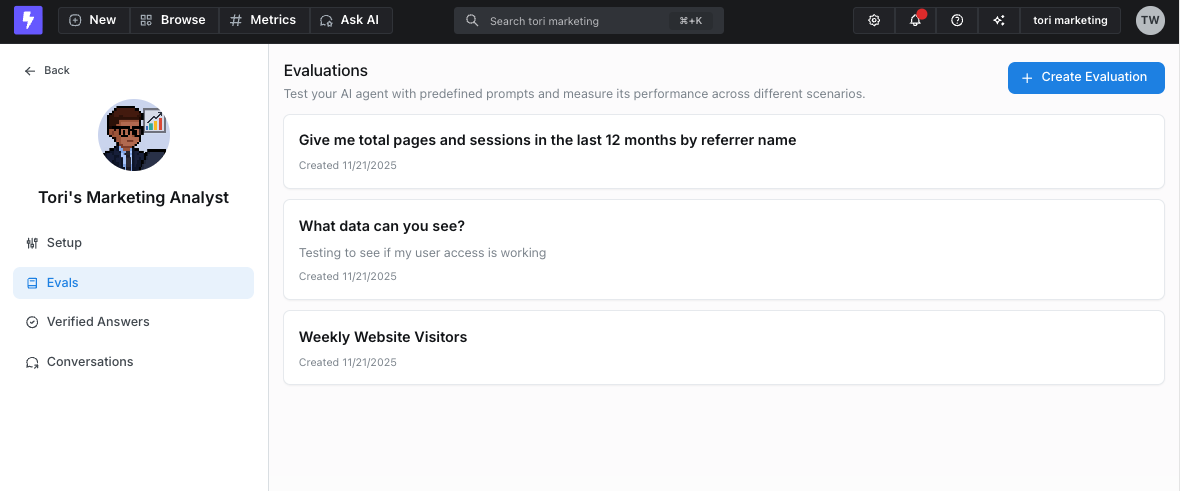
How evaluations work
-
Define evaluation questions - Build a set of test questions for each agent. You can either:
-
Manually create questions that represent common use cases
-
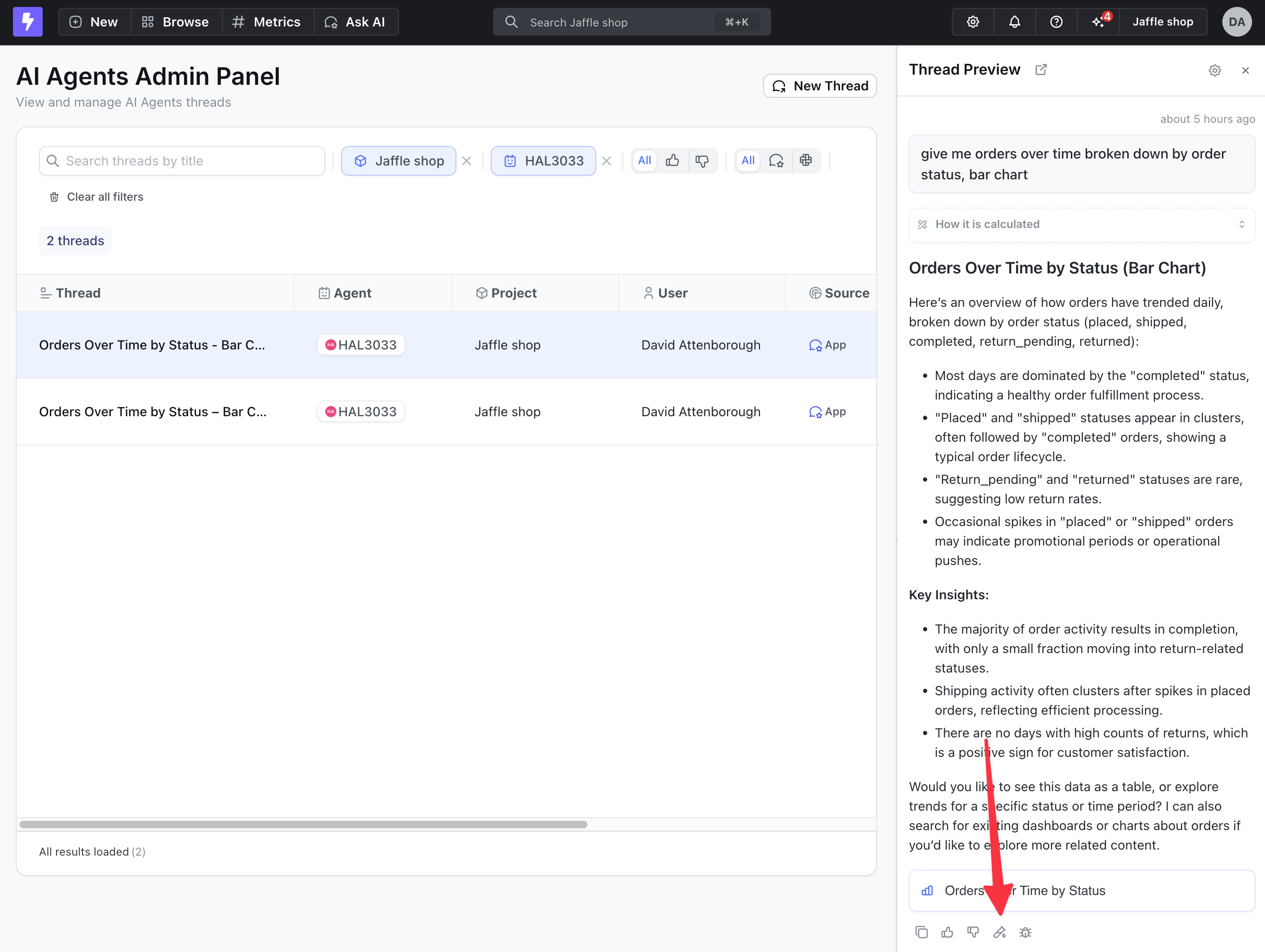
Select responses from existing agent conversations in the Threads tab to add to your evaluation set
-
-
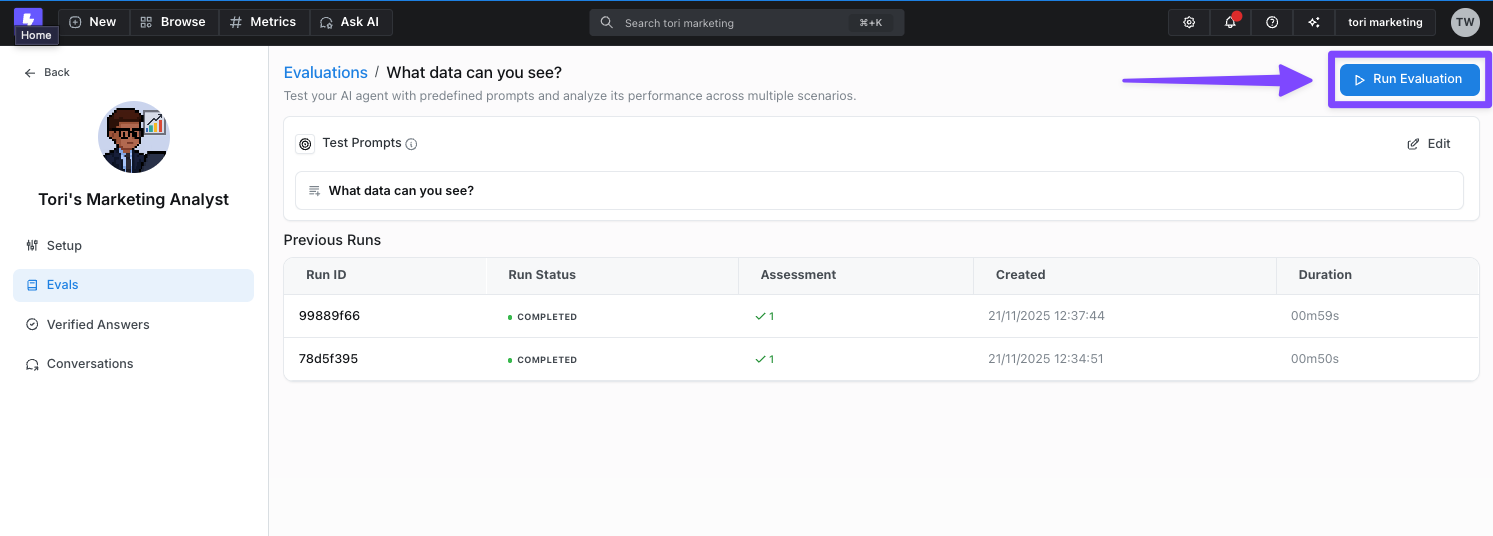
Run batch tests - Execute all prompts in your evaluation set against the agent to see how it responds
-
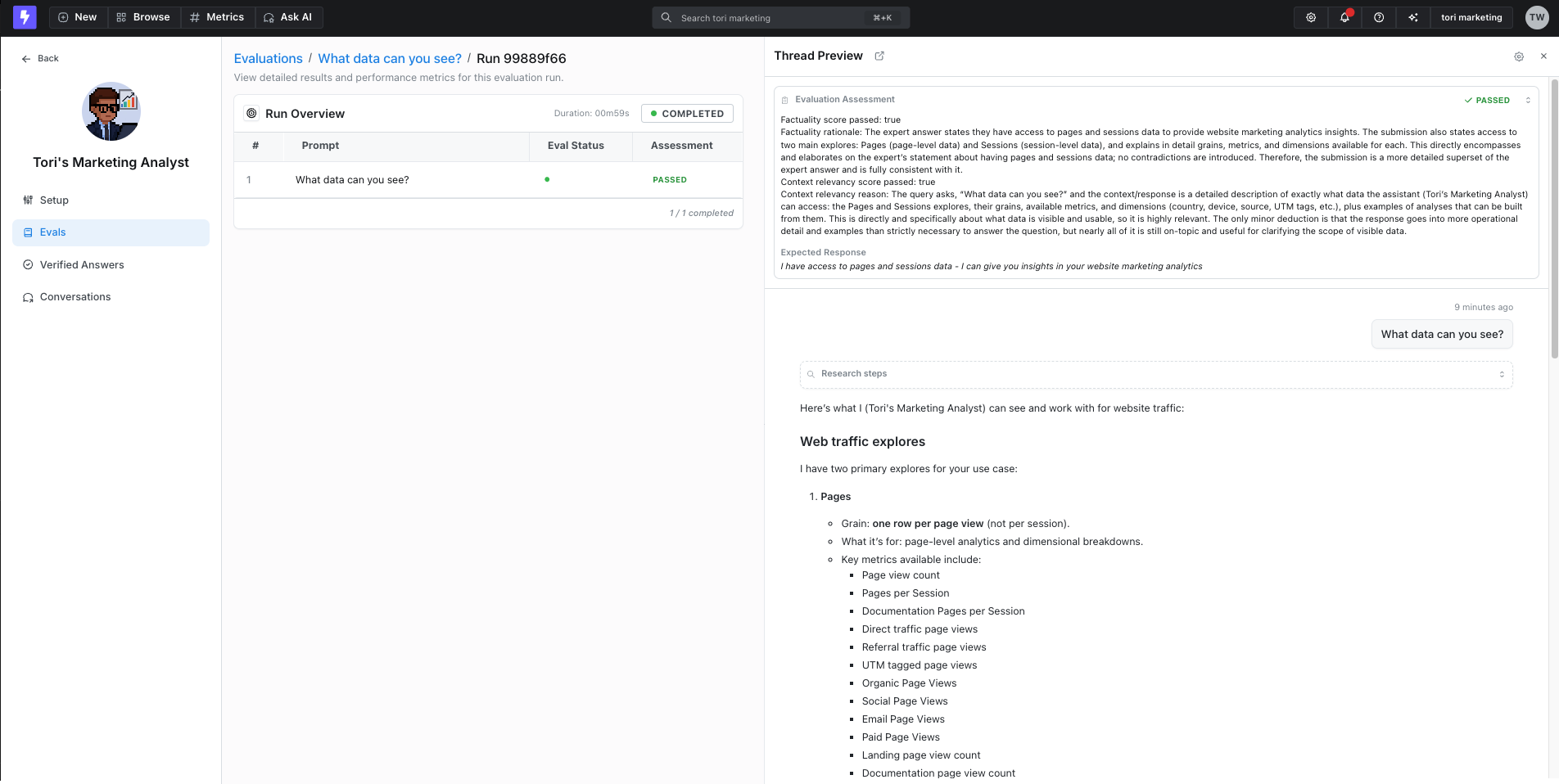
Review results - Manually review the agent's responses to ensure they meet your quality standards and expectations. When you provide an expected response, Qyra also runs an LLM-as-judge factuality scorer that automatically marks each result as passed or failed and shows its reasoning alongside your manual review
Writing questions and expected responses
Each evaluation prompt has two fields:
- Question (prompt) — the message you want to send to the agent, exactly as a user would type it. For example,
"What's our total order revenue in 2024?". - Expected response — a short, plain-language description of what a correct answer looks like. This field is optional; leave it blank if you only want to eyeball responses manually.
What "expected response" is (and isn't)
The expected response is not a word-for-word script the agent has to reproduce. Under the hood, when a run completes, Qyra sends the question, the agent's actual response, and your expected response to an LLM-as-judge that grades factual consistency, ignoring differences in style, grammar, and punctuation. The judge decides whether the agent's answer is a subset, superset, exact match, contradiction, or an unimportant difference — and only the first three count as a pass.
Because of that, the most effective expected responses are:
- Short and factual. Describe the key facts, numbers, or behaviour the answer must include — not the full sentence you'd like to see.
- Focused on content, not phrasing. Style, tone, and wording are ignored by the scorer.
- Specific about numbers when you know them. If a metric should return
1,189.60, put that value in the expected response so the judge can check for it. - Descriptions of behaviour when there's no single "right" number. For open-ended or ambiguous questions, describe what the agent should do (e.g. "asks for clarification", "returns a bar chart broken down by payment method").
You can write the expected response either as a single sentence or as a short bullet-style list of facts the answer must contain.
Examples
Concrete question / expected response pairs you can adapt:
Specific metric with a known value
What is our total order revenue in 2024?Replies with total order revenue of 1,189.60 for 2024.Chart or breakdown request
Revenue in Q3 2024 for the "credit_card" and "coupon" payment methods, displayed as a bar chart.Returns a bar chart from the payments explore showing total revenue broken down by payment method, with values for credit_card and coupon in Q3 2024.Ambiguous question — agent should ask for clarification
What's our revenue?Asks for clarification about which revenue metric and which explore to use, instead of guessing.Question the agent should refuse or explain a limitation for
Can you forecast the revenue for next quarter?Explains that it cannot perform statistical forecasting or predict future values.Empty-result question
Show me orders where the order amount is greater than 1000000.Replies with a message that there are no orders matching that filter.Multi-fact answer (list style)
What's the total order shipping cost by month in 2024, and how does it change month-over-month?Response contains total order shipping cost by month in 2024.
Response contains a month-over-month change for that shipping cost.
Uses the orders explore with a date dimension on the x-axis.A good rule of thumb: if two different correct answers would both satisfy your expected response when read side by side, it's specific enough. If either would fail because of wording alone, it's too strict — trim it back to the underlying facts.
Using feedback to improve evaluations
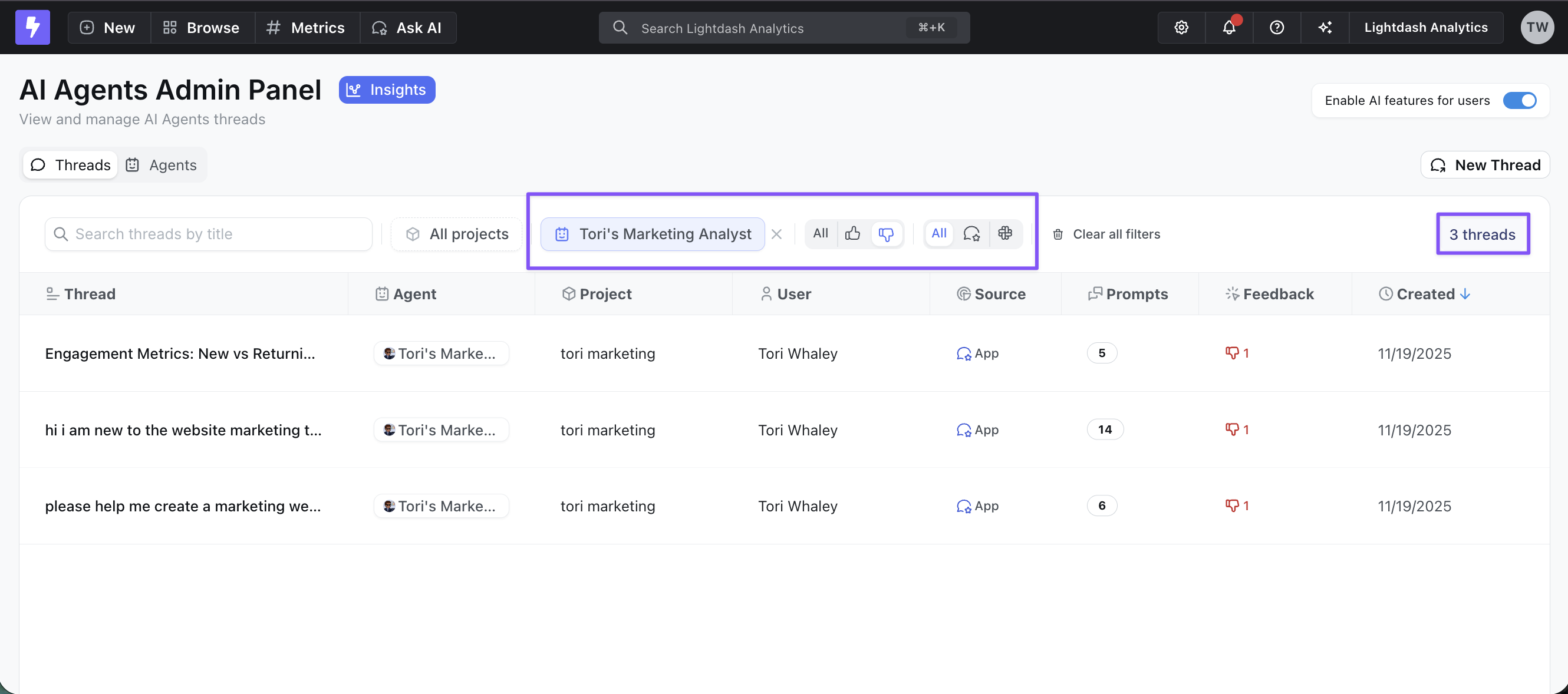
Encourage your team to actively use the thumbs-up/thumbs-down feature when interacting with AI agents. This feedback helps admins in two key ways:
- Identify improvement areas - Thumbs-down responses highlight where the agent needs work
- Build better evaluation sets - Filter and easily add thumbs-down responses to your evaluation suite to test fixes and prevent regressions
This systematic testing approach helps you:
- Verify agent performance before deploying changes
- Ensure consistency across common queries